

Best Times to Post on Instagram in 2026: What the Data Says and How to Find Yours
Two huge studies published in 2026 point to midweek as the best time to post, but they disagree on the hours. Here's what they say, what to do with it and how to find out when your own audience responds.
If you search for the "best time to post on Instagram," you'll find very confident and contradictory answers: "9 a.m.," "6 p.m.," "never on weekends." The truth is less convenient and more useful: there is solid data, but the time that works best for you depends on your audience.
Two large analyses were published in 2026. Let's look at what each one found, where they agree and how to use them without falling for the magic-hour trap.
What Buffer says: Wednesday and Thursday, midday and evening
Buffer analyzed 9.6 million Instagram posts made between January 2024 and December 2025, as part of a larger study of 52 million posts across ten networks. It measured engagement as the median of (likes + comments + shares + saves) ÷ followers, so that very large accounts don't skew the result, and it adjusted the times so they hold for any local time zone [1].
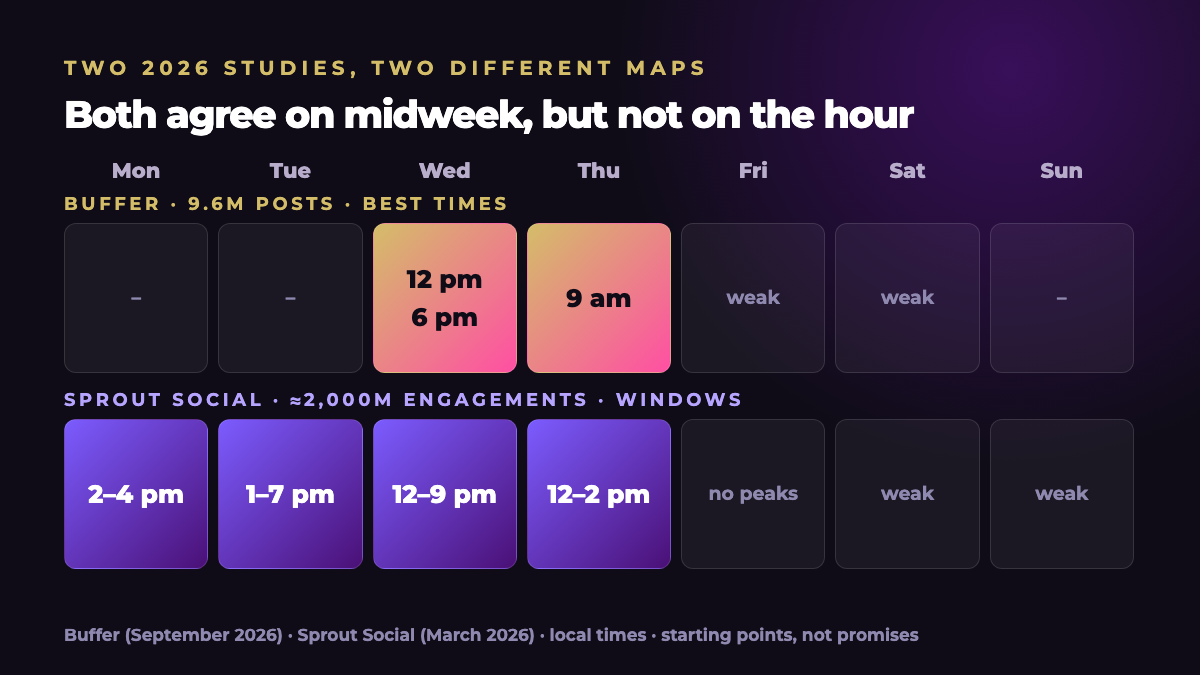
- Best times: Thursday at 9 a.m., Wednesday at noon and Wednesday at 6 p.m.
- Best days: Wednesday, followed by Thursday and Tuesday.
- Weekday evenings: 6 p.m. to 11 p.m. performed well every weekday except Thursday, when the morning (7 a.m. to 9 a.m.) won.
- Weakest: Friday and Saturday, and 1 a.m. to 5 a.m. on any day.
The authors themselves admit they don't know why Thursday at 9 a.m. stands out, and they remind readers that the time reflects when there is more interaction, not necessarily when your followers are online [1].
What Sprout Social says: weekday afternoons
Sprout Social analyzed the period from November 27, 2025 to February 27, 2026 using data from more than 30,000 customers. Its guide is based on about 2 billion engagements from about 307,000 profiles, but across several networks: the page doesn't break out how much of that is Instagram [2].
| Day | Window highlighted by Sprout (local time) |
|---|---|
| Monday | 2 p.m. to 4 p.m. |
| Tuesday | 1 p.m. to 7 p.m. |
| Wednesday | noon to 9 p.m., with a spike at 11 p.m. |
| Thursday | noon to 2 p.m. |
| Friday | No significant peaks |
| Saturday and Sunday | The weakest of the week, especially Saturday |
It also recommends avoiding the 3 a.m. to 7 a.m. window on weekdays [2].
Where they agree and where they don't
If you put the two studies side by side, there is some clear overlap and several differences:
- They agree: midweek (Tuesday through Thursday) is the strongest; weekends and the middle of the night are the weakest.
- They disagree: on Thursday (Buffer: 9 a.m.; Sprout: noon to 2 p.m.) and on evenings (Buffer sees good performance from 6 p.m. to 11 p.m.; Sprout, until 9 p.m. on Wednesday and 7 p.m. on Tuesday).
- Method differences: one covers Instagram only and measures with (likes + comments + shares + saves) ÷ followers; the other mixes several networks and uses its own definition of an engagement peak.
Treat these times as hypotheses, not rules. They're useful for starting to test next week; your own data should make the call.
How to find your best times in 4 steps
- Collect data from your last 20 or 30 posts. In your professional account's insights, note reach, likes, comments, saves and sends, along with the day and time you posted. Sprout also recommends checking the section showing when your followers are most active [2].
- Calculate the engagement of each post. Use Buffer's formula: (likes + comments + saves + sends) ÷ followers. If it's not clear, see our guide on how to calculate engagement.
- Group by day and time slot. Middle of the night, morning, midday, afternoon and evening is enough. Compare the averages and look at how many posts fall in each cell: with only one or two, don't conclude anything.
- Test for two weeks. Publish similar content in the top-scoring slots and measure again. Adjust, but don't change everything at once.
I made a spreadsheet that does steps 2 and 3 for you: you paste in your posts and it shows a heatmap with your best day and best time slot. It comes with sample data (made up) so you can see how it works.
Common mistakes when choosing a posting time
- Copying the time from a different account. A restaurant, a coach and a clothing store don't have the same audience or the same habits.
- Forgetting the time zone. If your audience is in another country, schedule by their local time.
- Mixing formats. Buffer analyzed all post types together and warns that Reels may have different peaks, so it suggests testing early morning and midday for them [1].
- Believing the time can save weak content. The authors say it themselves: timing won't rescue a weak post [1].
- Changing your schedule every week. That way you never build up comparable data.
Also remember that, according to Adam Mosseri, watch time, likes and sends are the main signals for ranking content on Instagram [3]. Timing only helps more people see that first window of opportunity; what decides the outcome is whether what you post deserves to be seen.
How Viral Strategist helps
Viral Strategist diagnoses your account and builds a strategy with a four-week calendar, so your frequency and format mix are decided before you start. After that, you can move each post to the time your own data points to. If you want a baseline calendar, you also have our free content calendar template.
Frequently asked questions
What is the best time to post on Instagram?
There's no universal time. Buffer, with 9.6 million posts, highlights Thursday at 9 a.m., Wednesday at noon and Wednesday at 6 p.m.; Sprout Social points to weekday afternoon windows. Use them as a starting point and confirm with your own insights.
What is the best day to post on Instagram?
Both studies agree that midweek performs best: Wednesday and Tuesday in both, with Thursday also strong in Buffer's. Weekends are among the weakest, and Friday doesn't stand out either.
Are the best times the same for Reels, carousels and images?
Not necessarily. Buffer analyzed all formats together and warns that Reels may have different peaks, so it recommends testing early morning and midday for them.
What time zone should I use for Instagram posting times?
Your audience's. Both studies report local time: if your audience is in another country, schedule by their time, not yours.
How many posts do I need to find my best time to post?
With about 20 posts you can start to see a trend, but each combination of day and time slot needs at least 2 or 3 posts for the comparison to mean anything. That's why it's worth measuring over several weeks.
Sources
Data and quotes checked against the original pages in October 2026. If a figure is old or comes from a single company's data, we say so in the text.
- Buffer. “Best Time to Post on Instagram in 2026: New Data from 9.6 Million Posts”. September 2026. buffer.com ↗
- Sprout Social. “Best times to post on Instagram in 2026”. Updated March 2026. sproutsocial.com ↗
- Andrew Hutchinson, Social Media Today. “Looking to improve your performance on Instagram in 2025?”. January 22, 2025 (quotes Adam Mosseri). socialmediatoday.com ↗