
How to Grow on Instagram: 8 Strategies That Actually Work (No Bought Followers)
Growing on Instagram isn't about a trick. It's about understanding which signals the platform looks at and what your audience wants. These 8 strategies combine what Instagram has said publicly with simple, practical habits.

If you search for how to grow on Instagram, you'll find hundreds of tricks: magic posting times, secret hashtags, formulas for "hacking" the algorithm. Almost all of them have one thing in common: nobody can prove they work. What you can do is start from what Instagram has explained about its own system and from what your audience needs.
Instagram rewards content that people watch, save and share. Growing is, to a large extent, making content that deserves those three actions, consistently, for a clear audience.

What Instagram says matters
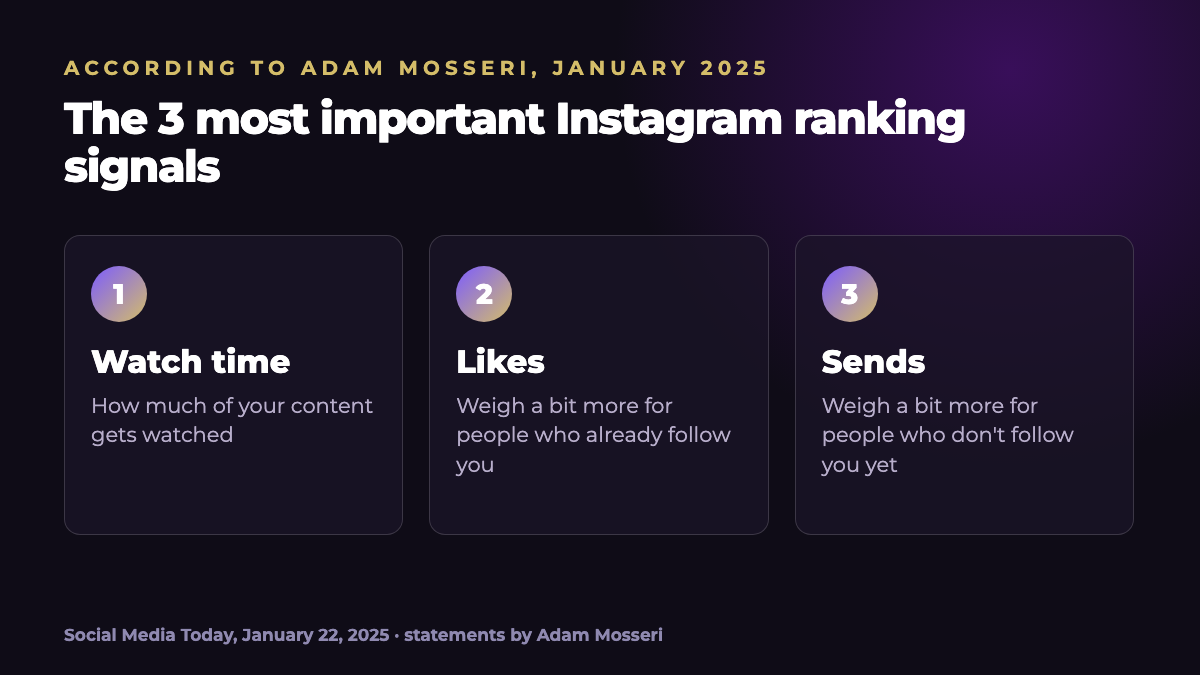
In 2023, Instagram explained that to rank your feed it considers things like each person's likes, shares, saves and comments, along with information about the post and about who posted it [1]. In January 2025, Adam Mosseri, the head of Instagram, summed up the three most important ranking signals as watch time, likes and sends, adding that likes carry a bit more weight for content from people who already follow you and sends a bit more for content from people who don't follow you yet [2].
With that in mind, the strategies below aren't tricks. They're ways to produce more of what the platform says it values.
1. Pick a niche and a specific audience
An account that talks about everything for everyone is hard to recommend and hard to remember. Define in one sentence who your account is for and what problem it solves for them. That sentence decides everything else: topics, tone, formats.
2. Treat your profile like your homepage
Someone who lands on your profile from a Reel decides within seconds whether to follow you. Check three things: a name and bio that say what you offer, a recognizable photo and a clear link. Pin your best posts at the top.
3. Post original content
In 2024, Instagram announced that when it detects identical content, it will recommend only the original, that it will label reposted content with a link to the original creator, and that it will stop recommending accounts that repeatedly post other people's content without adding anything [4]. Put differently: creating your own material and adding your own point of view is the safest bet.
4. Work on the first few seconds
Watch time is one of the main signals [2], and it all starts with the hook. Meta reports, for video ads, that up to 47% of a campaign's value was delivered in the first three seconds [5]. That isn't organic content data, but the lesson is the same: put the most interesting thing first. You have 12 hook formulas to practice with.
5. Be consistent before being intense
Buffer analyzed about 2.1 million posts from about 102,000 accounts and found that three to five posts per week looks like a balanced sweet spot, with roughly 12% more reach per post than posting once or twice [3]. It's a correlational study from a company that sells scheduling tools, and its authors stress that quality matters more than quantity. Choose a pace you can sustain and plan it with a content calendar.
6. Mix formats based on your goal
| Format | When to use it |
|---|---|
| Reels | Reach people who don't follow you yet. |
| Carousels | Teach step by step; they invite saves and sends. |
| Stories | Daily closeness, questions, polls. |
| Images and text posts | Quick ideas, quotes, announcements. |
Because sends carry a bit more weight for content from people who don't follow you yet [2], think about pieces someone would want to forward to a friend: a useful list, a surprising stat, a template.
7. Talk with your community
Reply to comments and messages, ask questions in your Stories, and comment on accounts in your niche with real contributions, not "love this!" Instagram says it considers your history of interaction with each person [1], and it's also the fastest way to find out what your audience needs.
8. Measure every month and adjust
Check your account insights to see which posts got the most reach, saves, sends and messages. Keep what worked, repeat the format and the type of hook, and drop what didn't. Before posting, you can evaluate your draft with a 7-signal checklist.
What doesn't work (or can't be proven)
- Buying followers: they don't engage and make your engagement look worse.
- Mass follow/unfollow: it's exhausting and rarely builds a community.
- Copying other people's content: it goes against what Instagram says it wants to reward [4].
- "Magic" times and hashtags: without data to back them up, you're better off testing with your own audience.
How Viral Score helps
Viral Score evaluates your draft before you publish it: a score from 0 to 100 with feedback, hook ideas, three improved versions of your text and hashtags. It's an estimate based on best practices, not a guarantee, but it helps you post with better judgment and learn which signals to improve on your account.
Frequently asked questions
How long does it take to grow an Instagram account?
There's no fixed timeline. It depends on your niche, your consistency and the quality of your content. A reasonable approach is to review your progress every month in reach, saves and messages, not just followers.
Does buying followers help you grow on Instagram?
No. Bought followers don't engage, they drag down your engagement rate and they hurt your credibility with brands and clients. It's better to grow more slowly with a real audience.
Are Reels or carousels better for growing on Instagram?
They do different jobs. Reels tend to help you reach new people, while carousels are better for explaining things and earning saves. The best approach is to combine both depending on the goal of each post.
Do you have to post on Instagram every day?
No. A Buffer study suggests that three to five posts per week is a good balance, but quality and consistency matter more than volume.
Sources
Data and quotes checked against the original pages in October 2026. If a figure is old or comes from a single company's data, we say so in the text.
- Instagram (Adam Mosseri). “Instagram Ranking Explained”. About Instagram, May 31, 2023. about.instagram.com ↗
- Andrew Hutchinson, Social Media Today. “Looking to improve your performance on Instagram in 2025?”. January 22, 2025 (quotes Adam Mosseri). socialmediatoday.com ↗
- Buffer (Kirsti Lang and Julian Winternheimer). “How Often Should You Post on Instagram in 2026? What Data From 2 Million Posts Tells Us”. August 13, 2025. buffer.com ↗
- Aisha Malik, TechCrunch. “Instagram is updating its ranking systems to surface more content from smaller, original creators”. April 30, 2024. techcrunch.com ↗
- Meta for Business. “Capture Attention with Updated Features for Video Ads”. Meta (no visible publication date). facebook.com ↗