
Instagram Hooks: 12 Formulas with Examples to Stop the Scroll
The first line of your post decides whether the rest gets read. These 12 formulas give you a starting point for writing hooks that spark interest without falling into clickbait.
If you publish content, you've lived this: you spend thirty seconds moving through the feed and almost nothing stops you. Your audience does the same with your posts. They decide in an instant whether to stay or keep scrolling, and what decides it is the hook.
A hook is the first sentence of your text, the cover of your carousel or the first second of your reel. It doesn't need to be clever: it needs to make the person think "this is for me" or "I want to know how this ends."
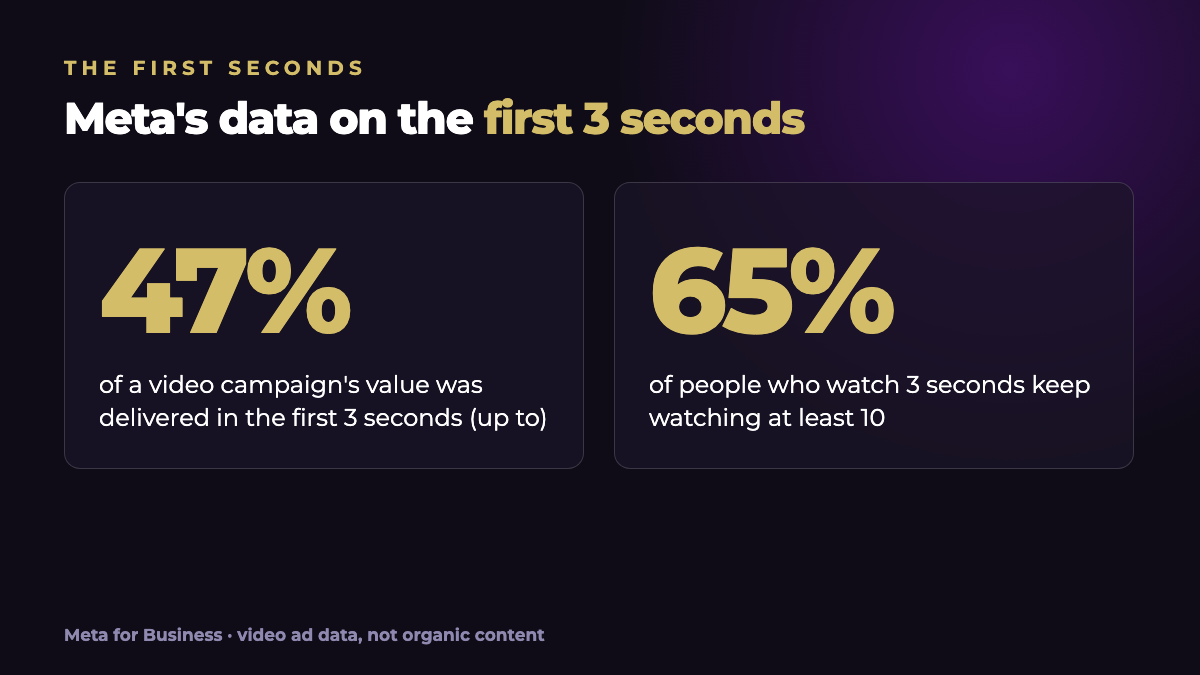
There's data backing up how much the first seconds matter. Meta, citing a study done with Nielsen, reports that up to 47% of a video campaign's value was delivered in the first three seconds, and that 65% of people who watch the first three seconds of a video keep watching for at least ten [1]. That's data from Meta video ads, not organic posts, but it points in the same direction. Text works similarly: Nielsen Norman Group estimated that on a web page you get to read at most 28% of the words [2].
A good hook has three parts: who it speaks to, what it promises and what tension it creates. It doesn't always need all three, but if it has none, it gets lost.
What makes a hook work
On top of that, watch time is one of the three main signals Adam Mosseri cited for Instagram's ranking [3]: a hook that keeps people watching works in your favor.
- Specificity. "How to save money" is vague. "How I saved $200 a month without giving up eating out" is something you can picture.
- Relevance. It speaks to your audience's problem or desire, not to you.
- Curiosity. It leaves an open question that the rest of the post answers.
- Payoff. What you promise, you deliver. If not, it's clickbait.
12 hook formulas for Reels and posts, with examples
The examples are generic. Swap in your own topic, your data and the way you talk.
1. The direct question
"Why aren't your posts reaching the people who should see them?"
Works when the question touches a real problem for your audience.
2. The common mistake
"The mistake almost every entrepreneur makes when setting their prices."
Nobody wants to make an avoidable mistake.
3. The specific number
"3 changes that got me more replies to my messages."
Numbers promise structure and speed. Use real data.
4. The "before and after"
"I went from posting with no plan to having the whole month ready in one afternoon."
It shows a possible transformation.
5. The contrarian take
"You don't need to post every day to grow."
It challenges a common belief. Back it up in the body of the post.
6. The "if you're…"
"If you sell services and struggle to explain what you do, this is for you."
It calls out a specific person. Whoever identifies with it, stays.
7. The one-line story
"Last month I almost shut down my business. Here's what I changed."
It sparks human curiosity. Only use it if it's true.
8. The secret or what nobody says
"What nobody tells you about working with influencers."
Careful: there has to be something genuinely valuable behind it.
9. The promise with a limit
"How to write a carousel in 15 minutes, without a designer."
The time limit and the condition make it believable and achievable.
10. The comparison
"Reels or carousels: which one is right for your goal."
It helps people decide, and people save what helps them decide.
11. The clear command
"Stop starting your posts with 'Hi everyone.'"
A short, direct instruction cuts through the scroll.
12. The list with a payoff at the end
"5 signs your profile isn't convincing (the fourth is the most ignored)."
It keeps the person watching until the end. Make sure the last point is worth it.
How to adapt a hook to each format
| Format | Where the hook goes | Tip |
|---|---|---|
| Reel | First second and on-screen text | Say or show the promise right away; skip long intros. |
| Carousel | Cover (first image) | Few words, large lettering and a clear promise. |
| Text or caption | First line, before the "more" cutoff | Make it understandable on its own, without depending on the rest. |
| LinkedIn post | The first two lines | A short sentence and a line break after it, to invite people to open it. |
Mistakes that weaken a hook
- Introducing yourself first. "Hi, I'm…" promises nothing to someone who doesn't know you.
- Being too vague. "Today I want to talk to you about marketing" creates no tension.
- Exaggerating. Promising "the ultimate secret" and delivering common advice costs you credibility.
- Burying the promise. If it takes three sentences to figure out what it's about, the hook has already failed.
How to test and improve your hooks
- Write three versions of the first line before creating the rest of the post.
- Pick the one that's most specific and that, read on its own, makes you want to keep going.
- Publish and note which formula you used.
- After several posts, compare reach and retention by formula type and repeat whatever responds best.
If you want to review the rest of the signals in your draft, see how to tell if your post will work before you publish it.
How Viral Score helps
Viral Score analyzes your draft and, besides a score from 0 to 100 with notes, suggests alternative hooks and three improved versions of your text. That way you can compare several hooks in seconds and pick the one that best fits your voice. It's an estimate based on best practices: the final decision and the test with your audience are still up to you.
Frequently asked questions
What is a hook on social media?
It's the first sentence of a text, the cover of a carousel or the first seconds of a video. Its job is to capture attention long enough for the person to keep watching or reading.
How long should a hook be?
Just long enough to spark interest: one short line in text and one or two seconds in video. If you need to explain it for it to make sense, it's too long.
Is a hook the same as clickbait?
No. A hook promises something and the content delivers it. Clickbait promises something the content doesn't deliver, and in the long run it costs you trust and audience.
How do I know which hook works best?
Test them: use different formulas on similar posts and compare reach, retention and saves. After ten or fifteen posts you'll see which structure your audience responds to best.
Sources
Data and quotes checked against the original pages in October 2026. If a figure is old or comes from a single company's data, we say so in the text.
- Meta for Business. “Capture Attention with Updated Features for Video Ads”. Meta (no publication date visible). facebook.com ↗
- Jakob Nielsen, Nielsen Norman Group. “Website Reading: It (Sometimes) Does Happen”. June 24, 2013. nngroup.com ↗
- Andrew Hutchinson, Social Media Today. “Looking to improve your performance on Instagram in 2025?”. January 22, 2025 (cites Adam Mosseri). socialmediatoday.com ↗