
How Much Do Influencers Charge? How to Estimate the Price
There is no official rate card: an influencer's price depends on many factors. Here is what they are, how to estimate a reasonable range and how to negotiate without overpaying.

"How much do influencers charge for advertising?" is the most common question before a campaign and the one with the fewest clear answers. The reason is simple: there is no price list. Every deal is negotiated, and the outcome depends on exactly what you are buying.
Instead of hunting for a magic rate, it pays to learn what drives the price and estimate your own range. That way you walk into the conversation knowing what is reasonable.
You are not paying for followers: you are paying for the attention of a specific audience, for the creation of the content and for the rights you get over it. The more of those three you buy, the higher the price.
What factors determine the price
- Size and real reach. How many people each post actually reaches matters more than the follower count.
- Engagement and audience quality. A community that responds and trusts the creator is worth more than a large, passive one.
- Niche. Finance, tech or health usually command higher rates than other topics, because of the value of their audiences.
- Country and market. Rates vary a lot from one country to another and depend on who is buying.
- Platform and format. A produced video costs more than a story; not every platform is worth the same.
- Production effort. Scripting, filming, editing, travel or showing the product on screen.
- Usage rights. If the brand reuses the content in ads or on its website, the price goes up.
- Exclusivity. Asking them not to work with your competitors for a period of time has a cost.
- Rush and volume. Fast turnaround or packages of several pieces change the rate.
That is why follower count is a poor starting point. According to a HypeAuditor study of almost 4.2 million accounts (2019), average engagement drops as an account grows [2]. It is old data, but it is a good reminder to ask for real stats instead of paying for size.
Most common payment models
| Model | How it works | When it fits |
|---|---|---|
| Flat fee | One price per piece or content package. | Awareness and campaigns with clear deliverables. |
| Product exchange | Product or service in return for content. | Small accounts and products that are valuable to that person. |
| Commission or affiliate | They earn a percentage of each sale they generate. | When you want to pay only for results. |
| Hybrid | A base fee plus a commission on results. | Shares the risk and aligns interests. |
A word of caution on product exchanges: even with no money involved, a free product still counts as a relationship with the brand. The U.S. FTC says influencers must disclose it clearly when they receive free products or discounts [1]. Put it in writing in the agreement, whatever the payment model.
A method to estimate a range
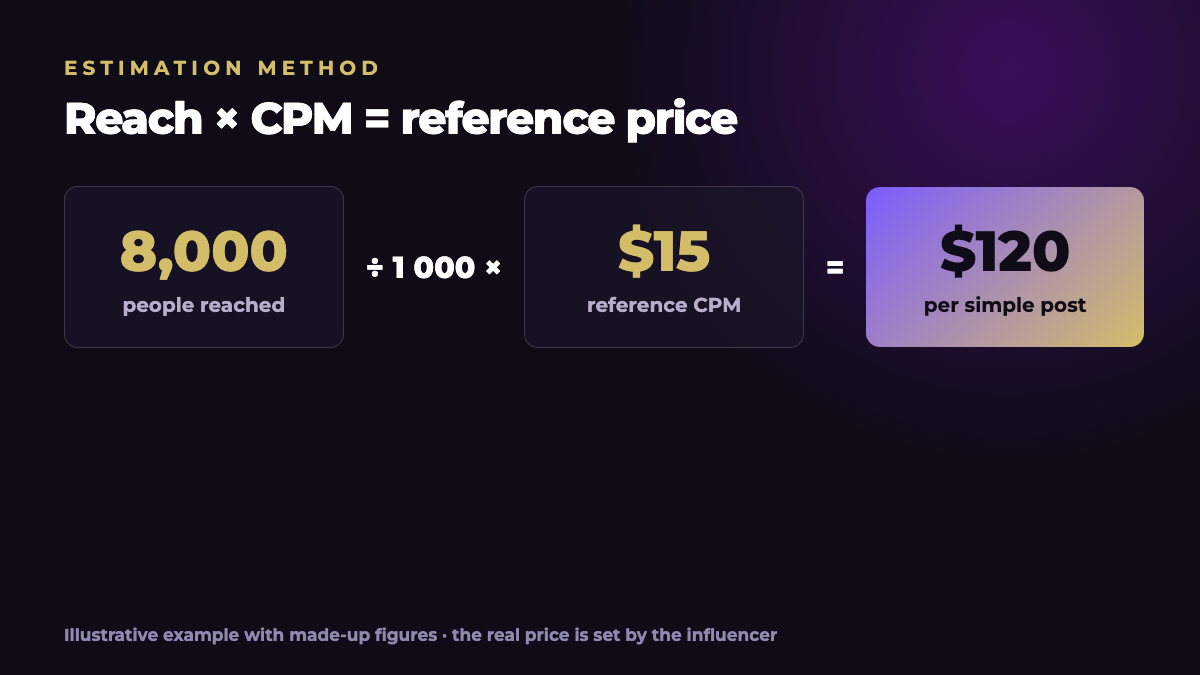
A practical approach is to calculate the cost per thousand people reached, known as CPM. Here is how:
- Ask for the average reach of their recent posts (not just the best one).
- Pick a reference CPM that seems reasonable for your country, niche and platform.
- Calculate:
reach ÷ 1,000 × CPM. - Adjust for production, usage rights and exclusivity.
The reference CPM is the hardest part to choose, because it changes a lot by market. That is why it helps to check it against real quotes from other, similar profiles.
How to negotiate without hurting the relationship
- Start with the goal, not the price. Tell them what you want to achieve and ask how they would approach it.
- Ask for an itemized quote: creation, posting, usage rights and exclusivity. That way you can see what to cut to fit your budget.
- Offer a package. Several pieces over a period of time usually bring a better price per piece and build trust.
- Test before you commit. A short collaboration gives you real data for the next one.
- Put everything in writing: deliverables, dates, approvals, usage rights, exclusivity and how you will pay.
Signs the price doesn't add up
- A very high price compared with the real reach their stats show.
- They refuse to show audience data but insist on closing fast.
- They promise guaranteed sales.
- They ask for full payment upfront with no contract.
Before talking money, make sure it is the right profile. If you are still not sure, read the 7 criteria for choosing an influencer.
How Viral Influencer helps
For each candidate, Viral Influencer gives you an estimated cost range based on the country you choose, the account size and the platform, along with a synergy score with your brand and any red flags it finds, with their sources. It is a reference range so you arrive prepared to negotiate: the real price is always set by the influencer or their agency.
Frequently asked questions
Is there a standard rate per follower?
No. There are market references, but pricing changes with the country, niche, platform, format, audience quality and the usage rights you ask for. Use them as a guide, never as a fixed price.
Is it better to pay per post or for results?
It depends on your goal. For awareness, a flat fee is usually enough. For sales, a hybrid model, with a base fee plus a commission on results, shares the risk between both sides.
Can you work with an influencer without paying money?
Yes, through a product exchange: you give a product or service in return for content. It works best with small accounts and when the product is genuinely valuable to that person. Even so, put in writing what is delivered and what is expected.
How do I know if I'm being overcharged?
Compare with other profiles of a similar size and niche, ask for audience stats and calculate the cost per thousand people reached. If the price is far above what you get for that reach on other channels, ask for a justification or negotiate.
Sources
Data and quotes checked against the original pages in October 2026. If a figure is old or comes from a single company's data, we say so in the text.
- Federal Trade Commission (FTC, U.S.). “Disclosures 101 for Social Media Influencers”. November 2019. ftc.gov ↗
- HypeAuditor. “Instagram Engagement Rate Benchmark 2018 vs 2019”. April 11, 2019. blog.hypeauditor.com ↗