
How to Make a Post Go Viral: 7 Signals to Check Before You Publish
Nobody can guarantee a post will go viral, but you can improve the signals that are in your hands. Here is a simple method to evaluate the viral potential of your draft before you publish.

Almost everyone publishes the same way: write, glance at the draft for a second, feel it's "good enough" and hit post. Then wait. When the post underperforms, it's not clear what went wrong, and the next one gets written with the same gut feeling.
There's a better alternative to guessing. Before publishing, you can check your draft against a fixed set of signals. It won't tell you for sure what will happen, but it will show you where the potential is and where you're wasting it.
A post doesn't go viral because of one thing. It performs when several signals are done well: a clear hook, a concrete idea, real value for the viewer and an easy way to act.

What makes a post go viral (and what you can't control)
It helps to separate two kinds of factors:
- The ones that depend on you: how the post starts, how clear the idea is, which format you choose, how it looks, what you ask people to do.
- The ones that don't: the exact moment the algorithm decides to show it, what other people post that day, your audience's mood that morning.
Instagram itself explains that, to decide what to show in the feed, it considers whether you've liked, shared, saved or commented, along with information about the post and about who posted it [1]. And Adam Mosseri, head of Instagram, said in January 2025 that the three most important signals for ranking are watch time, likes and sends [2]. In other words, the platform favors what people watch, save and share, and that looks a lot like the signals in this checklist.
A review method can only work on the first group, and that's fine. Improving what you control raises your average steadily, and over time that matters more than nailing any single post.
The 7 signals of a post with viral potential
1. The hook
This is the first line of the text, the cover of the carousel or the first second of the video. If it doesn't stop the scroll, the rest of the post barely gets read. Ask yourself: would someone who doesn't know me understand why it's worth reading on? If the hook introduces the topic instead of sparking interest, rewrite it.
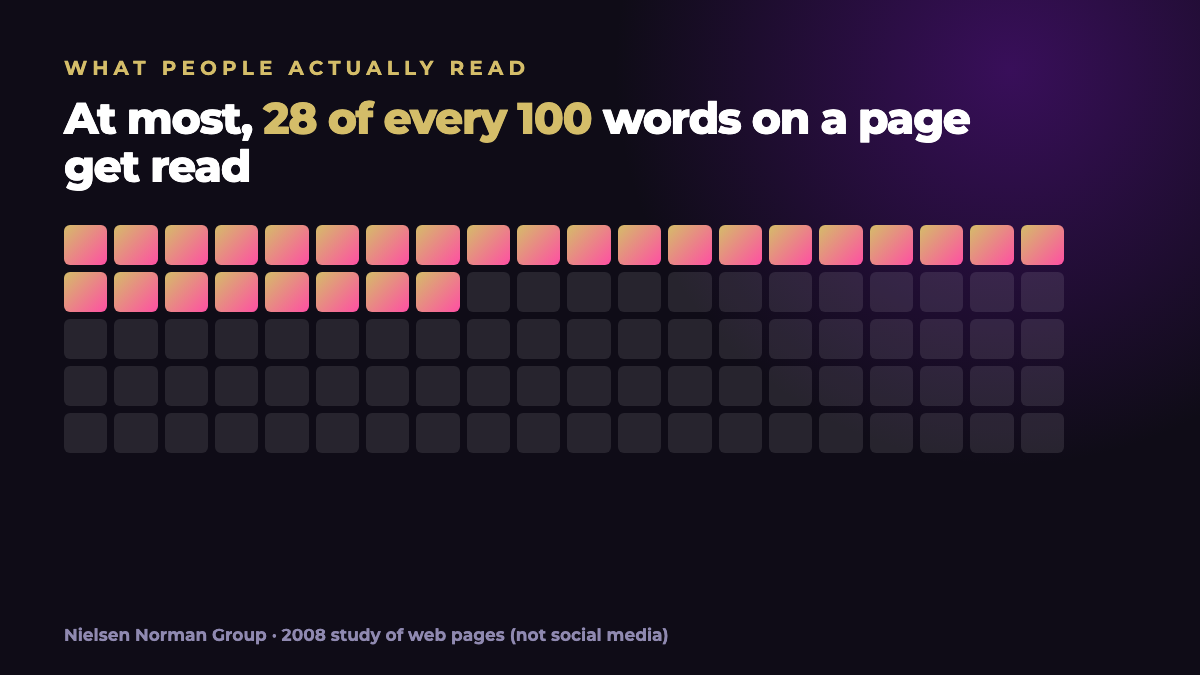
There's evidence that people scan more than they read. Nielsen Norman Group, a leading usability research firm, estimated in a 2008 study that on a typical web page visit there's time to read at most 28% of the words [3]. That's data from web pages, not social media, but it helps explain why the first thing people see carries so much weight.
2. A single idea
Posts that underperform often try to say three things at once. Sum up your post in one sentence. If you need two "ands," you have two posts.
3. Value for your audience
The post has to give something to the person viewing it: teach something, save them time, entertain them, help them decide or make them feel seen. An ad disguised as content almost always loses to something that solves a concrete problem.
4. A format that fits the platform
The same message works differently in a reel, a carousel or a long LinkedIn post. Choose the format based on what you want to achieve: a short video to reach new people, a carousel to explain step by step and get saves, a text post to start a conversation.
5. Credibility
A statistic, a real example, a before and after or a personal experience makes the post feel true. Promises with no proof ("multiply your sales") get ignored.
6. Call to action
What do you want the person to do when they finish? Save, comment, share, message you or visit a link. Pick one action and state it explicitly. Asking for three things at once is the same as asking for nothing.
7. Readability
Short paragraphs, enough contrast, large text in images and captions on videos, because many people watch without sound. Read your post on your phone with the screen at low brightness: if it's a strain, simplify.
A simple rubric to score your post before publishing
You can turn the seven signals into a score. Give each one 0, 1 or 2 points:
| Points | What it means |
|---|---|
| 0 | It's missing or poorly done. |
| 1 | It's there, but clearly could be better. |
| 2 | It's done well. |
The maximum is 14 points. A practical way to read the result:
- 12 to 14: publish it.
- 8 to 11: fix the signals that scored 0 or 1, starting with the hook.
- 0 to 7: the draft needs a rewrite. Better to spend 15 more minutes than to publish something that doesn't make the most of your audience.
Improved version: "Three months of testing roasts to land on this one: the blend that isn't bitter even with cold milk. Here's how we made it and where to try it." Now the hook promises something, there's a story, there's some proof and the action is clear.
Common mistakes that lower the potential
- Starting with "Hi everyone" or your name. Nobody stops for a greeting.
- Hiding the best part at the end. On social media people decide in seconds: put the most interesting thing first.
- Using random hashtags. A few relevant to the topic beat thirty generic ones.
- Copying another brand's format without adapting it. What works for an account with a different audience doesn't transfer one-to-one.
- Not making it clear who it's for. A post "for everyone" is usually for no one.
How to measure whether you got it right after publishing
Evaluating beforehand is of little use if you don't check what happened afterward. Look at three or four metrics and compare them against yourself, not against giant accounts:
- Reach: how many people it reached.
- Saves and shares: they usually signal the content was useful, and Mosseri named sends among the top signals [2].
- Substantive comments: more valuable than a "👏".
- Watch time or retention on video: it tells you whether the hook and the pacing worked.
Write down the score you gave each post and the result it got. After 10 or 15 posts you'll see which signals matter most to your audience, and that is worth more than any general rule.
How Viral Score helps
If you'd like someone else to run this review for you, Viral Score analyzes your Instagram, Facebook, LinkedIn or TikTok draft with AI and returns a score from 0 to 100 with notes, hook ideas, three improved versions of your text and hashtags. It's an estimate of potential based on copy, design and format best practices: it doesn't guarantee the post will go viral, but it shows you what to fix before you publish.
Frequently asked questions
Can you predict exactly whether a post will go viral?
No. Some factors are out of your control, like timing, the algorithm or whatever is dominating the conversation that day. What you can measure is potential: how well your post applies the copy, design and format practices that tend to work.
How many signals should I check before posting?
Seven is enough: hook, a single idea, value for your audience, the right format, credibility, call to action and readability. More than that tends to become an excuse not to publish.
Does this checklist work for any social network?
Yes, because the seven signals don't depend on a platform. What changes is the format (short video, carousel, long text) and how you measure results afterward.
What should I do if my post gets a low score?
Fix the hook and the clarity first, since they have the biggest effect. Then review the call to action. Score it again and publish once the draft clears the minimum you set for yourself.
Sources
Data and quotes checked against the original pages in October 2026. If a figure is old or comes from a single company's data, we say so in the text.
- Instagram (Adam Mosseri). “Instagram Ranking Explained”. About Instagram, May 31, 2023. about.instagram.com ↗
- Andrew Hutchinson, Social Media Today. “Looking to improve your performance on Instagram in 2025?”. January 22, 2025 (cites Adam Mosseri). socialmediatoday.com ↗
- Jakob Nielsen, Nielsen Norman Group. “Website Reading: It (Sometimes) Does Happen”. June 24, 2013. nngroup.com ↗