

How to Choose an Influencer for Your Brand: 7 Criteria That Matter
The influencer with the most followers is almost never the best fit for your brand. This guide gives you a method to compare them with good judgment, spot red flags and decide with data.

In influencer marketing, choosing the wrong influencer costs money, but it also costs time and reputation. Most mistakes come from the same place: picking by follower count and by the feeling that "the content looks good," without checking whether their audience resembles your customer.
The good news is that you can decide with an orderly process. Here's one.
A good influencer isn't the one with the most followers, but the one who best connects with the person you want to buy from you, with a real audience and a clean reputation.
How to choose an influencer for my brand: the 5-step process
- Define the goal. Do you want awareness, traffic, sales, downloads, content to reuse? Each goal changes who you should hire and how you measure it.
- Describe your ideal customer. Age, country, interests, what problem they have. This is the yardstick you'll measure everyone against.
- Build a long list. Gather 10 to 15 profiles that seem like a fit: topic searches, profiles that already mention your category, customer recommendations.
- Filter with the 7 criteria in the next section and keep 3 to 5.
- Run a small test before a big contract: one post or a short collaboration with clear metrics.
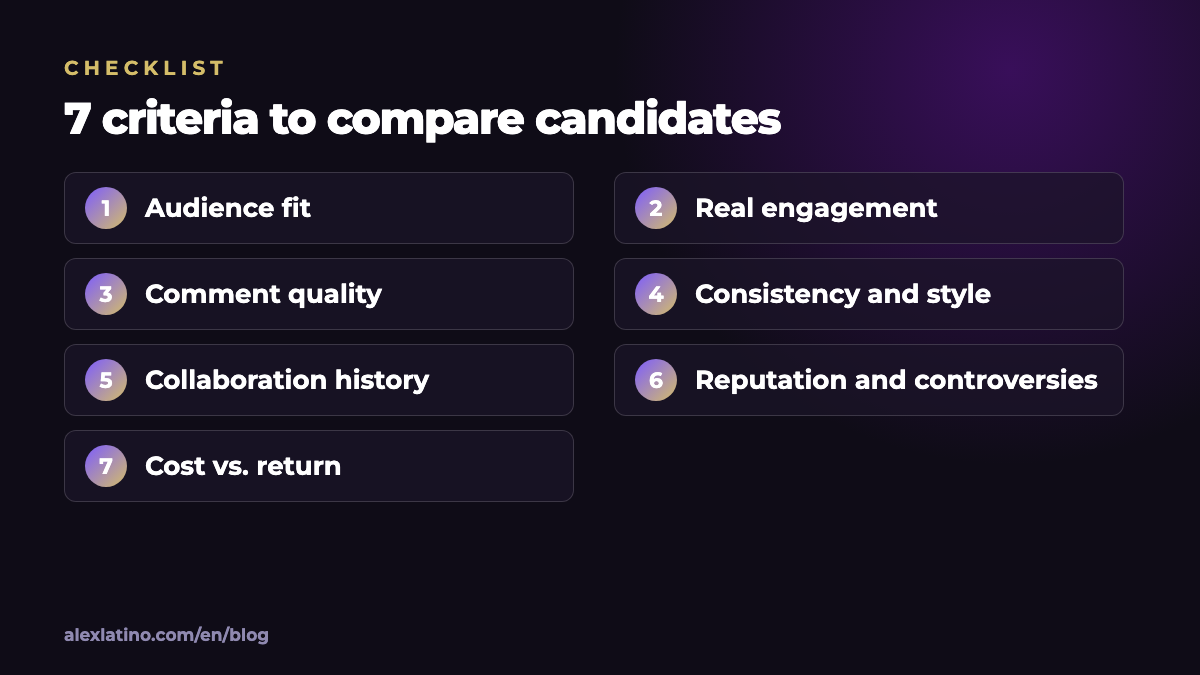
The 7 criteria for comparing candidates
1. Audience fit
This is the most important criterion. Ask for the stats, or ask about them: the age, country and gender of their followers. If you sell in one country and 80% of their audience is on another continent, the reach is useless to you no matter how huge it is.
2. Real engagement, not just followers
Look at how many people interact with their posts relative to their size. An account with 30,000 followers and real comments is worth more than one with 300,000 where almost nobody reacts. Check their last 10 to 15 posts, not just the best one.
A HypeAuditor study of nearly 4.2 million Instagram accounts, published in 2019, concluded that the more followers a profile has, the lower its engagement tends to be, and that accounts with fewer than 5,000 followers were the most active [1]. The data is old: treat it as a trend, not a number for today.
3. Comment quality
Read the comments. Is there conversation, questions, opinions? Or just emojis and generic phrases like "So cute!" over and over? A good community replies with context.
4. Consistency and style
Do they post regularly? Does their content keep its quality and a recognizable voice? A profile that's irregular or changes topic every week is hard to plan around and tends to deliver erratic results.
5. Collaboration history
Check which brands they've worked with and how they did it. If every third post is an ad for a different brand, the audience is already saturated and trust drops. If they've worked with direct competitors, clarify exclusivity terms.
6. Reputation and controversies
Search their name on Google alongside words like "controversy," "lawsuit" or "scam," and check news and reviews. An old, resolved controversy is not the same as a recent, unresolved one. What matters is that you verify it with sources, not rumors.
7. Cost versus expected return
Compare what they charge with the result you could expect. You don't need an exact forecast: a cautious estimate and knowing how much you need to sell or earn for the campaign to pay off is enough. To understand how a price is built, read how much influencers charge.
Red flags worth taking seriously
- Very sudden follower growth with no visible reason (a viral video, a media appearance).
- Interactions that don't add up: lots of likes and almost no comments, or lots of identical comments.
- An audience from countries that make no sense for their language or content.
- They refuse to share audience stats. A professional will show them.
- They promise guaranteed results ("I guarantee 10,000 sales"). Nobody can guarantee that.
- They ask for full payment upfront with no contract or delivery schedule.
Micro, mid-tier or macro: which one fits?
| Type | Advantage | Watch out for |
|---|---|---|
| Micro (small accounts) | Close community, direct contact, usually costs less. | Lower reach; you need to work with several. |
| Mid-tier | A balance of reach and trust. | More brands competing for their attention. |
| Macro (large accounts) | Awareness and fast reach. | High price, a less specific audience, sometimes less trust. |
If it's your first campaign, a mix of a few small profiles gives you more information for less money.
What to ask for and what to put in writing
Before you start, ask for the media kit or stats screenshots and examples of past collaborations with their results. And put the following in writing:
- What the deliverables will be (how many posts, in what format, on what dates).
- Who approves the content before it goes out.
- Whether the brand can reuse the content and for how long (usage rights).
- Whether there's exclusivity against competitors.
- How the result is measured and when payment is made.
- How sponsored content will be disclosed. In the United States, the FTC requires disclosing any relationship with a brand, including free products or discounts, in a way that can't be missed, and discourages vague terms like "collab" [2]. The rules in your country may differ, but this is a good reference.
How Viral Influencer helps
Viral Influencer compares the candidates you already have in mind against your brand and your campaign. It gives you a synergy score from 0 to 100, flags red flags with the sources so you can verify them and shows an estimated cost range. If a data point can't be found, the AI estimates it and labels it as an estimate. The real price is always set by the influencer or their agency, so use it as a starting point for deciding and negotiating.
Frequently asked questions
Is a micro-influencer better than a big one?
It depends on the goal. Small accounts tend to have closer communities and cost less, which is great for testing. Big ones deliver reach and awareness. For a first campaign, testing several small profiles and measuring is usually safer than betting everything on one big one.
How can I tell if an influencer has fake followers?
There's no perfect test, but there are warning signs: sudden growth with no explanation, generic or repeated comments, very little engagement relative to follower count, or lots of interaction from accounts in other countries that don't fit their audience. Ask for screenshots of their audience stats and compare.
What should I ask an influencer for before hiring them?
Their media kit or stats screenshots (audience age, country and gender), results from past collaborations, examples of sponsored content and their terms: deliverables, deadlines, usage rights and exclusivity.
How many influencers should I evaluate?
Three to five candidates is a good number: enough to compare properly without losing weeks. More than that rarely improves the decision.
Sources
Data and quotes checked against the original pages in October 2026. If a figure is old or comes from a single company's data, we say so in the text.
- HypeAuditor. “Instagram Engagement Rate Benchmark 2018 vs 2019”. April 11, 2019. blog.hypeauditor.com ↗
- Federal Trade Commission (FTC, U.S.). “Disclosures 101 for Social Media Influencers”. November 2019. ftc.gov ↗