

Instagram Content Plan and Calendar in 4 Weeks
Posting without a plan wears you out. With a four-week plan you decide once what to say, how and when, and after that you just execute. Here's the method and a template to copy.

The most common reason people abandon an Instagram account isn't a lack of ideas, it's a lack of system. Every day you have to ask yourself what to post, and that repeated decision drains more energy than creating does.
A monthly content plan, which is the foundation of your Instagram content strategy, fixes that. It doesn't have to be complicated: you need a goal, three or four topics, a calendar and a way to review what worked.
A content plan answers four questions: why you post, who it's for, what it's about and when. Everything else is execution detail.

Step 1: set a concrete goal
"Grow on Instagram" is not a goal. A good goal is specific, measurable and has a deadline. For example: "get 40 messages from people interested in my service this month" or "increase accounts reached by 300 per week."
One way to check is the SMART method, which George T. Doran proposed in 1981 in Management Review; its five letters stood for specific, measurable, assignable, realistic and time-related [1]. Today the version with "achievable" and "relevant" is the one most often taught, but the idea is the same. If you can't tell at the end of the month whether you hit it, it's not a goal yet.
Step 2: know your audience
Write down in five lines who your ideal customer is: what they do, what problem they have, what worries them and where they look for help. That description decides the tone, the topics and even the format. If you don't know where to start, go through the messages and questions you get asked most.
Step 3: choose 3 or 4 content pillars
Pillars are the big topics you'll post about. Each one serves a different purpose:
- Educate: you teach something useful (tips, common mistakes, tutorials).
- Connect: you show the person or team behind the brand (stories, processes, values).
- Prove: evidence that it works (case studies, results, customer opinions).
- Sell: you present your offer directly (services, promotions, how to work with you).
A reasonable proportion is to put most of your content into educating and connecting, and reserve a smaller share for selling. If everything you post is a sales pitch, people stop listening.
Step 4: decide on formats
Each format plays a role:
| Format | Use it to |
|---|---|
| Reels | Reach people who don't follow you yet. |
| Carousels | Explain in depth, so people save and share it. |
| Images and text | Quick ideas, quotes, announcements. |
| Stories | Daily closeness, polls, questions, updates. |
You don't have to use them all. Pick the two or three you can be consistent with.
A useful data point for deciding: Adam Mosseri, head of Instagram, said in 2025 that likes carry somewhat more weight for content from people who already follow you, while sends via message carry somewhat more weight for content from people who don't follow you yet [2]. That's why it's worth making some of your content useful enough that someone wants to send it to another person.
Step 5: build your social media posting calendar (4 weeks)
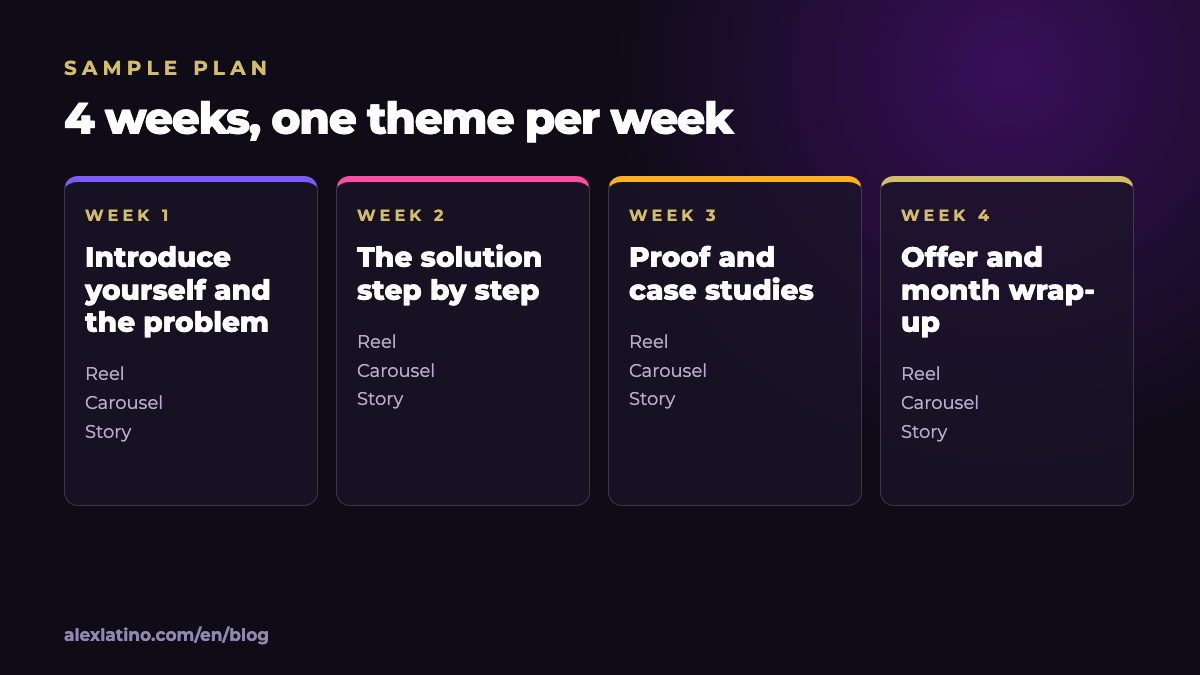
A sample split, with three posts per week. Change it to fit your pace:
| Week | Theme of the week | Posts |
|---|---|---|
| 1 | Introduce yourself and the problem | Reel showing the problem · "Common mistakes" carousel · Story with your own case |
| 2 | The solution, step by step | Tutorial carousel · Reel with a tip · Q&A post |
| 3 | Proof | Customer case study · Before-and-after reel · Testimonial |
| 4 | Offer and month wrap-up | "How to work with me" carousel · Reel with the offer · Recap and call to action |
Leave at least one slot free each week for something timely or a new idea.
Step 6: use a template for every post
So you don't start from scratch every time, define these pieces on a card before you create:
- Pillar and goal: what role this post plays.
- Format and date.
- Hook: the first line or the first second. 12 hook formulas can help here.
- Core idea: just one, in a sentence.
- Call to action: save, comment, message, visit a link.
- Text, hashtags and assets (photos, videos, designs).
Step 7: batch your production
Set aside a block of time, say one morning, to write all the captions and shoot or design the month's material. After that you just publish. Switching into "creative mode" once instead of twelve times saves a lot of time.
Step 8: measure and adjust
When the fourth week ends, review which posts performed best against your goal: reach, saves, messages received. Keep what worked, drop what didn't and adjust next month. A plan is more useful when it learns from what happened.
How Viral Strategist helps
Viral Strategist diagnoses your account and delivers a marketing strategy based on your data: a SMART goal, pillars and, depending on your plan, the four-week calendar with the captions and scripts for each post. You can edit the strategy before generating the calendar. It doesn't publish for you: it hands you the plan and the copy, ready to use or to take to your scheduling tool.
Frequently asked questions
How many times a week should I post on Instagram?
The frequency you can sustain for months. Posting three times a week with quality and consistency beats posting six times for two weeks and disappearing. Start at a realistic pace and increase it only if you can keep it up without strain.
How many content pillars do I need?
Between three and five. Fewer than three gets repetitive and more than five dilutes your message. Each pillar is a big topic your audience expects you to talk about.
Is a 4-week plan too rigid?
It doesn't have to be. Planning isn't the same as blocking changes: leave one or two slots a week for timely topics and adjust the plan based on what you see in your metrics.
What do I do with ideas that don't fit any pillar?
Keep them in a separate list. If an idea keeps coming up or performs well, it may deserve its own pillar; if not, don't post it just to fill the calendar.
Sources
Data and quotes checked against the original pages in October 2026. If a figure is old or comes from a single company's data, we say so in the text.
- George T. Doran. “There's a S.M.A.R.T. way to write management's goals and objectives”. Management Review, 70(11), 35–36, November 1981. decisionskills.com ↗
- Andrew Hutchinson, Social Media Today. “Looking to improve your performance on Instagram in 2025?”. January 22, 2025 (cites Adam Mosseri). socialmediatoday.com ↗