

Influencer Marketing Guide: 6 Steps to Get Started
Working with influencers can deliver results, but it can also be an expensive way to learn what you should have defined first. This guide takes you from zero to a first campaign with goals, a brief and measurement.

Influencer marketing means partnering with people who have their own audience so they present your product or service. It works when that audience looks like your customer and trusts the person speaking. It doesn't work when you hire someone just because they have a lot of followers.
This guide explains how to start without overspending: what to define beforehand, how to set up the collaboration and how to tell whether it was worth it.
An influencer campaign is won before you contact anyone: with a clear goal, a defined audience and a way to measure. The influencer executes; the strategy is yours.
Why so many brands are using it
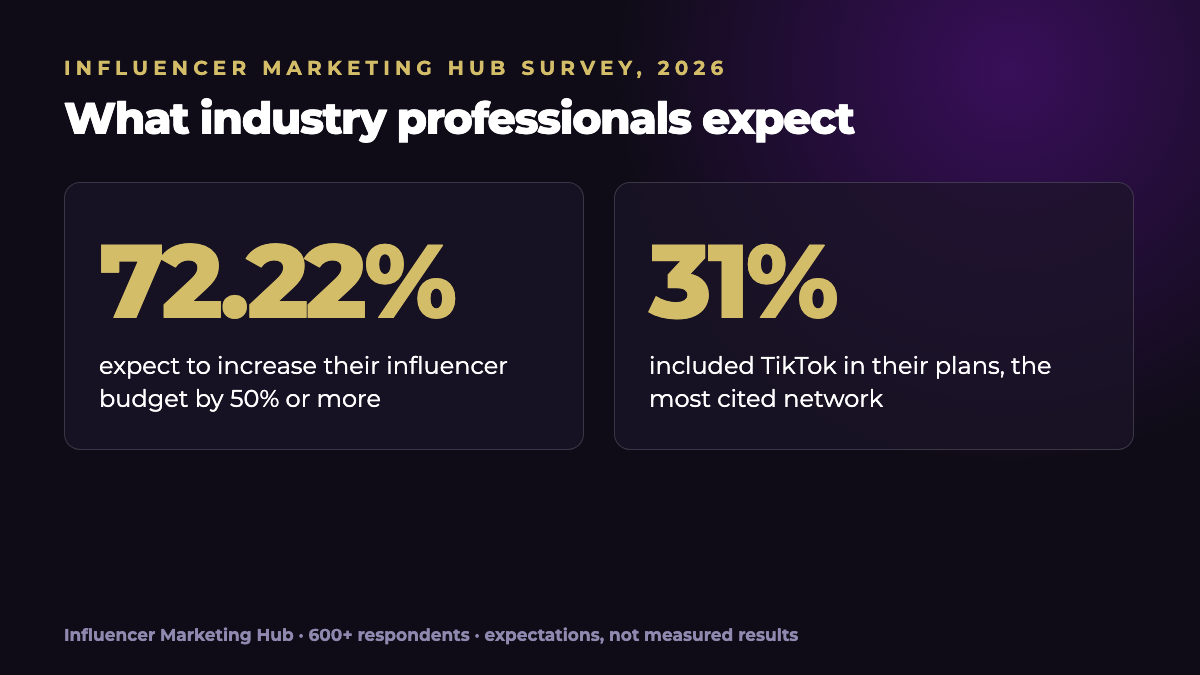
Influencer Marketing Hub published its annual report in May 2026, based on a survey of more than 600 industry professionals. According to that report, 72.22% of respondents expect to increase their influencer budget by 50% or more, and TikTok was the platform most often included in plans, at 31% [1].
Two caveats about that data: these are answers from industry professionals to a survey run by a company that lives off this market, and they reflect expectations, not proven results. They are useful for seeing the trend, not for promising outcomes.
Most common types of collaboration
| Type | How it works | Best for |
|---|---|---|
| Paid post | You pay a fee for one or several pieces of content. | Awareness and launches. |
| Product exchange | You give a product or service in return for content. | First tests with small profiles. |
| Affiliate or commission | The influencer earns a percentage of each sale made with their code or link. | Measurable sales with low risk. |
| Ambassador | An ongoing relationship over several months. | Brands that have already validated the profile. |
| Content for your channels | The creator produces pieces that you publish or use in ads. | Brands that need their own material. |
How to get started: 6 steps
1. Define a measurable goal
Awareness, traffic, sales, downloads or content. Pick one and give it a number and a date. If you want 200 visits to your website in a month, you will know at the end whether it worked.
2. Set a test budget
Decide how much you are willing to invest in order to learn. It is better to spread it across a few small profiles than to spend it all on one. If you need pricing guidance, see how much influencers charge for advertising.
3. Describe your ideal customer
Age, country, interests and the problem you solve. It is the yardstick you will use to compare each candidate.
4. Find and filter candidates
Build a list of 10 to 15 profiles and narrow it to 3 to 5 using clear criteria. The guide to choosing an influencer will help here. A HypeAuditor study of almost 4.2 million Instagram accounts (2019) found that engagement tends to drop as an account grows [3], so don't rule out small profiles because of their size.
5. Write a clear brief
A good brief fits on one page and includes:
- Who you are and what you offer, in three lines.
- Campaign goal and main message.
- Deliverables: how many pieces, in what format and by what dates.
- What must appear (product, link, code) and what to avoid.
- How the post will be disclosed as an ad.
- Approval and payment process.
Leave room for creative freedom: the influencer knows their audience better than you do.
6. Measure and decide
When it ends, compare against the goal and decide: repeat, adjust or stop. The next section explains how.
What to measure and how to calculate it
- Reach and impressions: how many people saw the content.
- Engagement: comments, saves and shares.
- Traffic: visits to your website from a link with UTM parameters unique to each influencer.
- Sales: orders using a discount code specific to each profile.
Two useful calculations:
- Cost per thousand people reached (CPM):
investment ÷ reach × 1,000. - Return on investment (ROI):
(revenue − investment) ÷ investment.
Advertising rules: disclose that it's an ad
The FTC, the U.S. authority, says any relationship with a brand must be disclosed clearly, including free products or discounts, that the disclosure must sit next to the endorsement and not be buried at the end or behind a “see more” link, and that vague terms like “collab” are discouraged [2]. Every country has its own regulations, but these guidelines are a good reference. Include how to disclose it in the agreement.
Common mistakes when starting out
- Choosing by follower count instead of audience fit.
- Not defining how to measure until after the post goes live.
- Over-controlling the script. If it sounds like an ad, the audience notices.
- Expecting instant sales from a single post.
- Paying everything upfront with no contract or schedule.
How Viral Influencer helps
Viral Influencer compares the candidates you already have in mind against your brand and your campaign: a synergy score from 0 to 100, red flags with their sources and an estimated cost range. If a piece of data is missing, the AI estimates it and marks it as an estimate. It is an aid for deciding better before you hire; the real price is always set by the influencer or their agency.
Frequently asked questions
What is influencer marketing?
It is a form of advertising where a brand partners with people who have their own audience and its trust, so they present a product or service. It can be paid, done in exchange for product, or based on commission.
How much budget do I need to start?
It depends on the goal and the size of the profiles. A test with a few small profiles can be done on a modest budget, and it gives you real data to decide whether to scale. What matters is deciding up front how much you are willing to lose if the test doesn't work.
Do I have to disclose that a post is an ad?
In many countries, yes, and the rules vary. In the United States, the FTC requires clear disclosure of any relationship between the influencer and the brand. Check the regulations in your country and put it in writing in the agreement.
How do I know if the campaign worked?
Compare the results with the goal you set: reach, traffic, sales, downloads. Use links with UTM parameters or unique discount codes to see what came from each profile.
Sources
Data and quotes checked against the original pages in October 2026. If a figure is old or comes from a single company's data, we say so in the text.
- Influencer Marketing Hub. “Influencer Marketing Benchmark Report 2026”. May 4, 2026 (survey of more than 600 people). influencermarketinghub.com ↗
- Federal Trade Commission (FTC, U.S.). “Disclosures 101 for Social Media Influencers”. November 2019. ftc.gov ↗
- HypeAuditor. “Instagram Engagement Rate Benchmark 2018 vs 2019”. April 11, 2019. blog.hypeauditor.com ↗